Pascal's Triangle II
LeetCode 119 | Difficulty: Easy
EasyProblem Description
Given an integer rowIndex, return the rowIndex^th (0-indexed) row of the Pascal's triangle.
In Pascal's triangle, each number is the sum of the two numbers directly above it as shown:
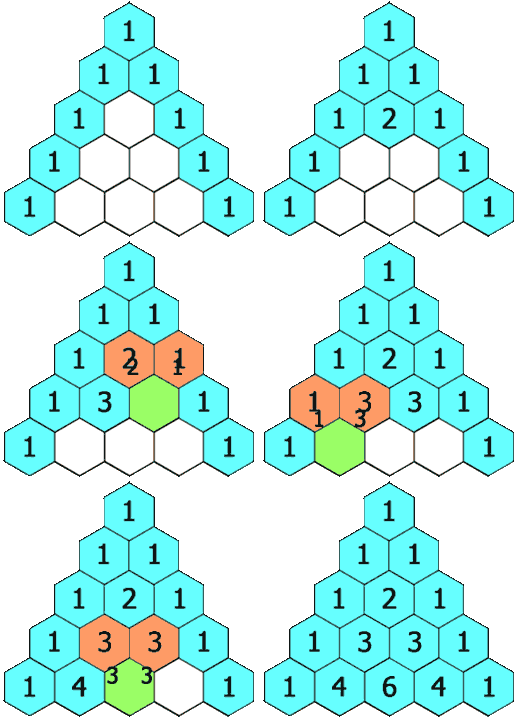
Example 1:
Input: rowIndex = 3
Output: [1,3,3,1]
Example 2:
Input: rowIndex = 0
Output: [1]
Example 3:
Input: rowIndex = 1
Output: [1,1]
Constraints:
0 <= rowIndex <= 33
Follow up: Could you optimize your algorithm to use only O(rowIndex) extra space?
Topics: Array, Dynamic Programming
Approach
Dynamic Programming
Break the problem into overlapping subproblems. Define a state (what information do you need?), a recurrence (how does state[i] depend on smaller states?), and a base case. Consider both top-down (memoization) and bottom-up (tabulation) approaches.
When to use
Optimal substructure + overlapping subproblems (counting ways, min/max cost, feasibility).
Solutions
Solution 1: C# (Best: 204 ms)
| Metric | Value |
|---|---|
| Runtime | 204 ms |
| Memory | 24.9 MB |
| Date | 2019-12-15 |
Solution
public class Solution {
    public IList<int> GetRow(int rowIndex) {
        int[] A = new int[rowIndex+1];
	A[0] = 1;
	for (int i = 1; i <= rowIndex; i++)
	{
		for (int j = i; j >= 1; j--)
		{
			A[j] += A[j-1];
		}
	}

	return A.ToList();
    }
}
📜 2 more C# submission(s)
Submission (2020-02-21) — 208 ms, 25.4 MB
public class Solution {
    public IList<int> GetRow(int rowIndex) {
        int[] A = new int[rowIndex+1];
	A[0] = 1;
	for (int i = 1; i <= rowIndex; i++)
	{
		for (int j = i; j >= 1; j--)
		{
			A[j] += A[j-1];
		}
	}

	return A.ToList();
    }
}
Submission (2017-11-11) — 445 ms, N/A
public class Solution {
    public IList<int> GetRow(int rowIndex) {
	IList<IList<int>> rows = new List<IList<int>>();
	rows.Add(new List<int>() { 1 });
	for (int i = 1; i <= rowIndex; i++)
	{
		var row = new int[i + 1];
		row[0] = 1;
		row[i] = 1;
		for (int j = 1; j < i; j++)
		{
			row[j] = rows[i - 1][j - 1] + rows[i - 1][j];
		}
		rows.Add(row);
	}
	return rows[rowIndex];
    }
}
Complexity Analysis
| Approach | Time | Space |
|---|---|---|
| Dynamic Programming |
Interview Tips
Key Points
- Start by clarifying edge cases: empty input, single element, all duplicates.
- Define the DP state clearly. Ask: "What is the minimum information I need to make a decision at each step?"
- Consider if you can reduce space by only keeping the last row/few values.